

 Textile Industry
 Wood, Furniture and Construction Industry
 Paper, Printing and Packaging Industry
 Medical, Industrial and Home Type Glove Industry
 Filter and Metal Industry


How to Clean Glue and Remove Glue Stains
The PVA, Acrylic Emulsions, and SBR/NBR Latex-based adhesives developed by our company are formulated to deliver maximum bond strength and rapid curing performance across industrial sectors such as woodworking, packaging, and textiles. While the high cohesion strength of our products is a vital advantage for production quality, accidental contact with unintended surfaces, application equipment, or skin necessitates professional cleaning procedures to maintain structural and surface integrity.
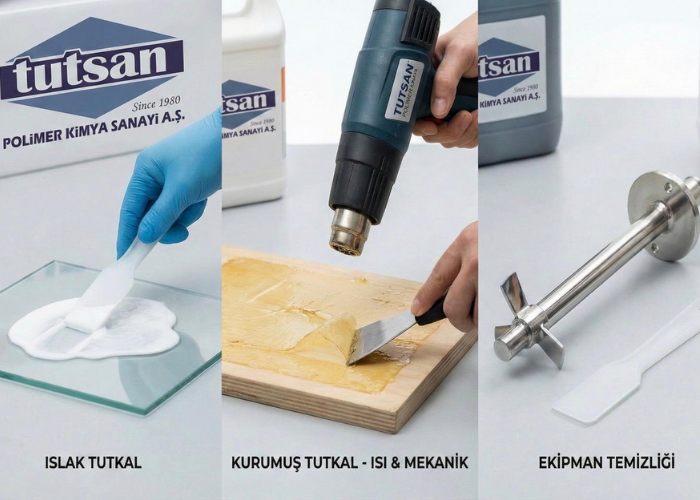
1. Cleaning Uncured (Wet) Adhesive Residue
One of the primary operational advantages of our water-based polymer dispersions (PVA, Acrylic, etc.) is their solubility in water before the polymerization process is complete and a film layer has formed.
- Timing of Intervention: Cleaning must be performed immediately, before the "open time" expires and the product begins to turn transparent (the film-forming stage).
- Mechanical Removal: Excess adhesive should be carefully scraped off using a flexible plastic spatula or a card that will not damage the substrate.
- Final Cleaning: The remaining thin residue should be wiped with a clean cloth or sponge dampened with warm water. It is critical to use clean sections of the cloth progressively to avoid spreading the adhesive further across the surface.
2. Removal of Cured (Dried) Polymers from Surfaces
Once the water has evaporated and the adhesive has "set," it forms a film layer that is highly resistant to water and external factors. At this stage, cleaning relies on thermal or mechanical principles.
- Hard Surfaces (Wood, Metal, Composites):
- Thermal Method: Using a heat gun, the residue is heated to reach the polymer's Glass Transition Temperature (Tg). This softens the layer, allowing it to be mechanically peeled or scraped from the surface with ease.
- Long-Term Hydration: For water-resistant metal or plastic components, soaking the parts in warm water for 24–48 hours can cause the polymer structure to swell, breaking its bond with the surface.
- Textiles and Porous Surfaces:
- Aggressive scraping can damage fibers in fabrics where the polymer has penetrated. We recommend a warm water bath to soften the polymer as much as possible before attempting gentle removal.
3. Maintenance of Industrial Application Equipment
Regular cleaning of mixer shafts, adhesive reservoirs, and dosing units is essential to optimize production costs and extend the service life of expensive equipment.
- Stainless Steel Equipment: Dried polymer layers on stainless steel often tend to detach as a single, peelable film. For stubborn residues, equipment should be submerged in warm water tanks until the bond weakens, followed by mechanical peeling.
- Plastic Components: Similar softening and peeling methods should be applied to plastic spatulas or hoppers, using tools that do not compromise the plastic’s surface finish.
4. Skin Cleaning and Safety
A common mistake in production facilities is using industrial solvents like thinners to remove adhesive from the skin. In accordance with Occupational Health and Safety (OHS) standards, our company strictly advises against this practice.
- Correct Procedure for Wet Adhesive: If the polymer is still wet, wash the skin thoroughly with plenty of warm water and soap.
- Removal of Dried Residue: The film layer on the skin should be softened using oil-based products such as baby oil, petroleum jelly (Vaseline), or natural oils, then gently rubbed off. Industrial-grade granulated hand cleaners are also effective for safely removing polymers through mechanical friction. The safest long-term approach is periodic washing with warm water throughout the day to allow the polymer to naturally detach from the skin’s surface.
10 March 2026